

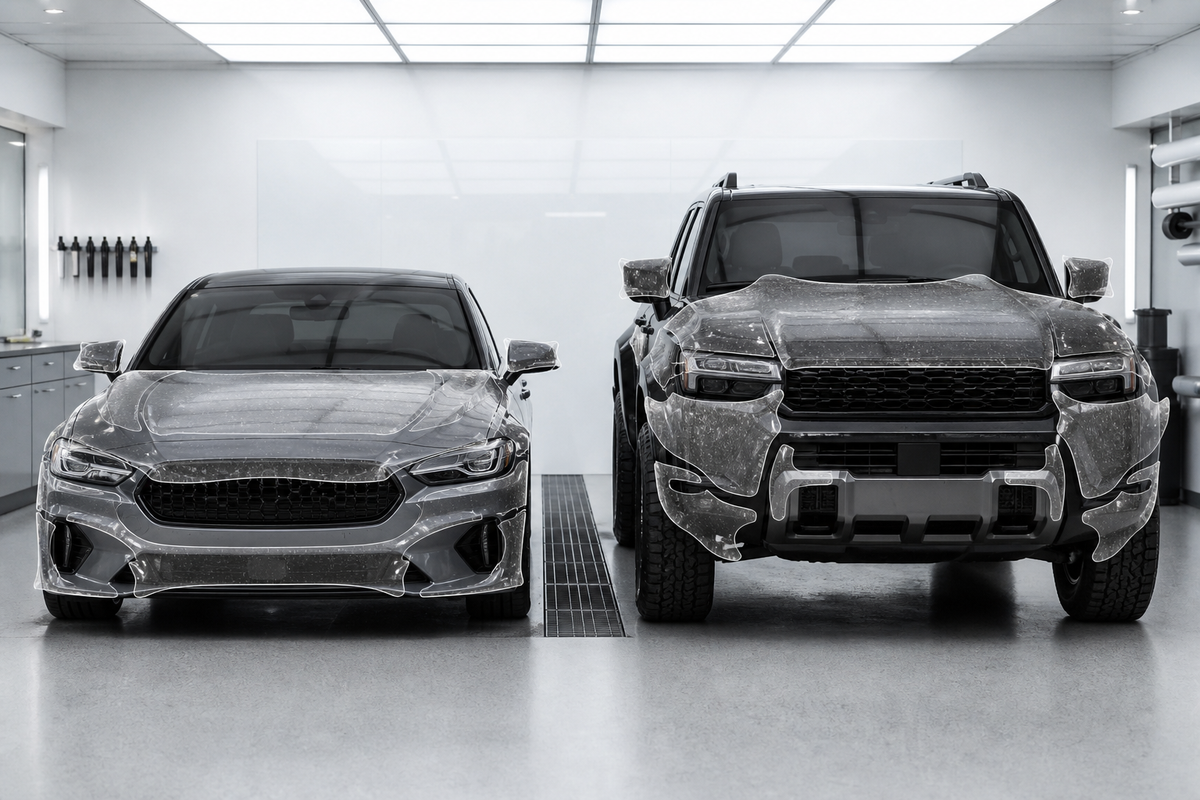

Quick answer: Sedan full front and SUV full front solve different ownership problems. Use the comparison below, approve physical samples or a real tool path, measure the actual vehicle, and treat $765.99–$1,629.99 USD as dated material context—not a complete installed quote.
Verified facts that shape this decision
- Current U.S. storefront examples put a 7.5mil clear Gloss PPF sale listing at $765.99 USD and visible colored PPF listings at $1,629.99 USD; this is product context, not an installed full-front quote. Live storefront basis.
- Tesla's current Model 3 manual lists a 185.8-in overall length and 72.8-in body width excluding mirrors.
- Ford lists the 2026 Bronco Base four-door at 189.4 in long and 75.9 in wide with mirrors folded.
Estimate by named panels, not by vehicle class alone
| Option | Visual or work effect | Planning issue | Best fit |
|---|---|---|---|
| Sedan full front | Hood, front bumper, front fenders, mirrors | Lower height; broad hood may still exceed simple roll assumptions | Build patterns for each panel |
| SUV full front | Same named zones plus taller bumper and upright faces | More height, hardware and compound sections | Separate flares and grille surrounds |
| Partial front | Bumper plus leading hood/fenders | Lower material but visible film line | Acceptable only after finish-edge review |
Define full front in writing
A common full-front scope includes hood, front bumper, both front fenders and mirror caps, but shops may add headlights, A-pillars, rocker starts or door cups. List every included and excluded part before comparing material or labor.
Measure the hood at its working extremes
Record maximum length and width across the surface, then account for edge returns and handling margin. A vehicle's published overall width is not hood width. The Model 3 example deliberately shows why the two numbers cannot be substituted.
Treat the bumper as several geometric problems
A bumper combines openings, corners, recesses and protrusions. The visible area may look smaller than the hood while requiring more handling film or planned pieces. Let the exact film's conformability and installer process decide whether one piece or inlays are appropriate.
Separate SUV hardware
Grille surrounds, recovery points, flares, sensors, cameras and textured plastic can change access and substrate suitability. The estimator should flag each component for remove, exclude, template or wrap-in-place review rather than assigning one SUV multiplier.
Use a cut map, not a blanket waste rate
Place measured panel rectangles and pattern shapes across the usable roll width. Preserve film direction where required. Add handling margin panel by panel. This method makes the source of extra material visible instead of hiding it inside an unsupported percentage.
Plan left-right symmetry
Mirror caps and paired fenders should follow the same material direction and comparable stretch. Mirroring a template can save planning time, but confirm the vehicle is actually symmetrical and that sensors or trim do not change one side.
Choose clear or colored PPF before pricing
Clear gloss aims to preserve paint appearance; colored PPF changes it. A colored full front over a different body color usually creates an intentional two-tone design, not invisible protection. Coverage and product type must therefore be decided together.
Keep product price separate from installed price
The dated $765.99-$1,629.99 figures are storefront examples. A complete quote also needs selected roll length, freight or taxes, templates, prep, paint correction, parts removal, labor and contingency for damaged or contaminated pieces.
Inspect the pattern plan before cutting
Review seam locations, film edges, sensor openings and excluded substrates on the actual vehicle. A paper or digital plan should show which piece comes from which roll area and where a second attempt would come from if a complex bumper section fails.
Build the delivery record
Save the product handle, lot, roll width and length, panel list, install date, care instructions and any spare film. Photograph edges and seams after curing. This record makes later maintenance and repairs measurable rather than anecdotal.
Vehicle-size examples with a verified basis
Tesla Model 3 sedan
Tesla's current Model 3 owner's manual lists 185.8 in (4,720 mm) overall length and 72.8 in (1,850 mm) width excluding mirrors; values are approximate and configuration-dependent. Official dimension source. Tesla lists the Model 3 at 185.8 in long and 72.8 in wide excluding mirrors. The width is 12.8 in greater than a nominal 60-in roll, proving that body width is not a direct one-piece hood measurement. These published dimensions are a comparison basis; measure the actual panels, parts and edge returns before ordering.
2026 Ford Bronco Base four-door SUV
Ford lists the four-door Bronco Base at 189.4 in long, 75.9 in wide with mirrors folded, and 73.0 in high with the soft top. Official dimension source. Ford lists the 2026 Bronco Base four-door at 189.4 in long, 75.9 in wide with mirrors folded and 73.0 in high. Its extra 3.6 in of length versus the Model 3 is less important to a full-front estimate than its taller, more segmented front geometry. These published dimensions are a comparison basis; measure the actual panels, parts and edge returns before ordering.
Price range in USD on August 18, 2026
The verified U.S. storefront context for this article is $765.99–$1,629.99 USD. Current U.S. storefront examples put a 7.5mil clear Gloss PPF sale listing at $765.99 USD and visible colored PPF listings at $1,629.99 USD; this is product context, not an installed full-front quote. This range does not combine taxes, local labor, freight exceptions, paint correction, disassembly, failed-piece allowance or future removal. Confirm the exact product, variant, availability and sale state when ordering.
- Measure every named panel at its widest usable points.
- Define jambs, roof, bumpers, trim, hardware and edge returns as included or excluded.
- Reserve direction and same-lot material where the exact finish requires it.
- Price preparation and installation separately from the roll or tool.
Installation guidance with an attributable basis
3M's Protection Wrap Film guide emphasizes a clean environment, like-new finish, avoiding over-stretch and thorough edge post-heating for its named system. The estimator therefore reserves geometry and handling margin but never invents a universal waste percentage or heat setting. Read the manufacturer bulletin.
- Inspect paint, repairs, textured plastics, sensors and moving parts.
- Photograph the approved sample, coverage boundary or cutting path.
- Build a panel-by-panel cut and direction map before opening the roll.
- Prepare the surface only with the exact film maker's permitted products.
- Use heat, solution, edge treatment and post-heating only as the selected system documents.
- Inspect after cooling or curing, record the product and lot, and deliver care instructions.
Commercial and editorial next steps
Compare the verified product and collection options below, then return to WINWAYWRAP vehicle-wrap materials for the current store view.
Related reading:
Questions to settle before approval
Can published vehicle dimensions replace measurements?
No. They make the sedan and SUV examples comparable, but they do not describe hood width, bumper depth, mirror geometry, aftermarket parts or the installer's handling margin.
Is the low price a full-vehicle price?
No. It is the low end of the specifically dated storefront context described above. Coverage, roll length, material family and service scope must match before prices are compared.
Can the installation setting in one bulletin be copied to another film?
No. The bulletin supports a practical workflow and shows what must be documented. The exact purchased film's current technical sheet controls temperatures, solutions, conformability, edge treatment and care.
What makes the final decision defensible?
Keep four records together: the approved physical sample or tool path, the measured cut map, the dated USD material source and the exact installation bulletin. If one is missing, keep the project in planning rather than forcing a purchase.
Final decision
Full-Front PPF Estimator: Sedan vs SUV Panels, Waste and Price is not a choice that a color name, tool name or vehicle class can answer alone. Select the option whose appearance and workflow still make sense after the actual vehicle, repair plan, care routine and complete quote are considered.
Create a repair plan before installation
Identify which panel is most likely to be damaged and whether Sedan full front or SUV full front can be replaced as one bounded piece. Save the exact product handle, lot, direction and a clean labeled offcut when practical. A first-day seamless look should not make a later repair unnecessarily broad.
Use a written acceptance checklist
Inspect the result in open light and side light. Check finish consistency, edges, seams, moving parts, sensors, trapped contamination and alignment with the approved plan. Photograph the accepted condition and keep the care sheet with the invoice.
Translate measurements into usable material
Draw each panel as a measured rectangle or pattern on the usable roll width, preserve direction, and add the handling margin chosen by the installer. Bumpers and compound parts deserve separate pieces because visible area alone understates their working-film demand.
Check the delivered material before cutting
Match the product title, handle, color, finish, width, length and lot to the order. Inspect packaging and a small unrolled section under neutral light. If multiple rolls are required, compare them before the first visible panel is installed.
Document the ownership plan
Record washing method, storage conditions, stain response, inspection timing and future removal guidance for the exact material. These variables can change which of the comparison options is genuinely easier to own.
Compare the complete quote
Put material, preparation, disassembly, installation, contingency and future repair assumptions on separate lines. Confirm that both Sedan full front and SUV full front use the same coverage definition. A price comparison is not useful when one quote includes bumpers, mirrors or correction work that the other quietly excludes.
Approve the result in more than one light
Review the chosen option in open daylight, shade and the indoor light where the vehicle is usually parked. For a tool or installation decision, repeat the review under side light that exposes the edge or seam. Keep dated photographs with the approval record so a later question can be compared with the agreed reference.
Set a stop condition
Write down what makes the project pause: questionable paint, a missing technical sheet, an unavailable matching lot, a sensor conflict, an unsupported substrate or a measurement that does not fit the selected roll. A stop condition prevents schedule pressure from turning an unresolved assumption into a permanent cut or installation.
Review the handoff package
The owner should receive the exact product name, install date, care limits, inspection timing and removal guidance. The installer should retain the cut map, lot, approved sample and photographs of hidden seams or edges. This shared record is more useful than a generic claim that the material is easy to install or maintain.
Recheck scope after any vehicle change
Aftermarket mirrors, spoilers, flares, racks, repaired panels or replacement bumpers can invalidate an earlier estimate. Reinspect and remeasure after those changes. The published sedan and SUV dimensions remain useful context, but the altered vehicle becomes the source of truth for cutting and access.
Run a small process test
Use a representative scrap panel or approved test area to confirm tool contact, surface appearance, solution behavior or finish direction before committing the most visible panel. Record what was tested and which exact product instructions were used. A process test should answer a defined question; it is not customer evidence or a substitute for training.
Protect the spare material
If a spare offcut is retained, label it with product, lot, vehicle-front direction and install date. Store it under the supplier's stated conditions, clean and protected from damage. A random curled scrap in a hot trunk is not a reliable repair reference.
Distinguish appearance from protection
A finish can look substantial without having the construction or testing of paint-protection film, while a clear protective film may barely alter appearance. Describe the selected material by its documented family and intended use. Do not turn a styling film into a rock-chip claim or treat every protective film as a color-change product.
Close the loop after installation
Schedule the first inspection according to the product and installer's process. Review edges, seams, recessed areas, contamination and moving parts after the material has settled. Record any correction and update the owner copy so the final documentation matches the delivered vehicle rather than the original estimate.
Keep assumptions visible
Mark every estimate, visual inference and unverified option as provisional until the actual vehicle, product record and technical sheet confirm it. Clear assumptions make the final approval faster because the buyer can see exactly which decisions are settled and which still need evidence.
Share:
7.5mil Gloss vs Matte PPF: Finish, Installation and Ownership
Satin White PPF vs Satin Pearl White Vinyl: What Changes and What Protects