

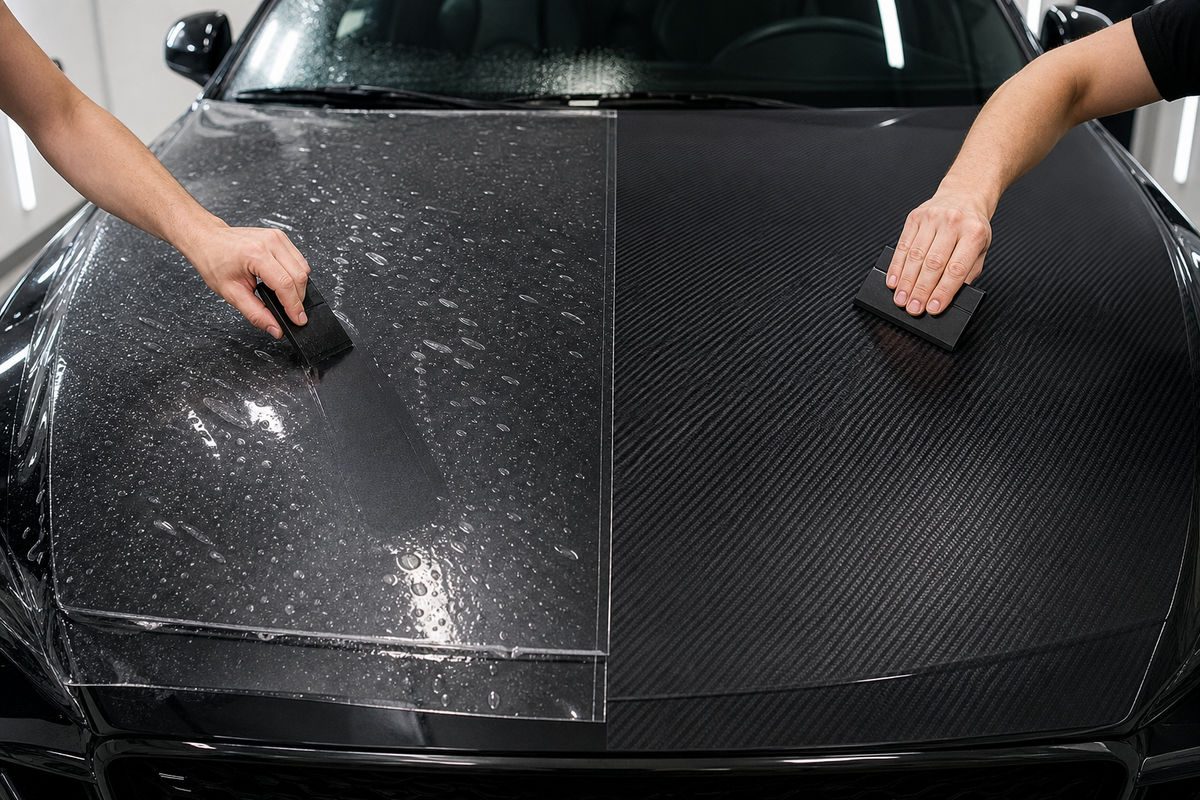
Quick answer: Carbon fiber PPF prioritizes paint protection with a thicker protective film and a carbon-style appearance. Carbon fiber vinyl prioritizes affordable styling and easier dry application. Choose PPF for impact resistance on high-risk panels; choose vinyl when the visual carbon effect and budget are the main goals.

| Factor | Carbon fiber PPF | Carbon fiber vinyl wrap |
|---|---|---|
| Primary purpose | Paint protection plus appearance | Appearance and color change |
| Typical construction | Thicker protective film, often TPU-based | Thinner color-change vinyl |
| Installation | Usually wet application | Usually dry application |
| Impact resistance | Higher | Limited |
| Cost | Higher material and specialist labor | Lower and more DIY-accessible |
| Removal | Professional technique recommended | Generally simpler when film and paint are healthy |
What carbon fiber PPF is
Carbon fiber PPF combines a visible carbon-style surface with the protective role of paint protection film. Its thicker construction is designed to absorb more abrasion and stone impact than ordinary decorative vinyl. Product properties differ, so verify thickness, topcoat, self-healing claims and warranty for the exact film.
PPF is related to products such as gloss paint protection film and matte PPF, but a carbon pattern is a separate appearance choice. Do not assume every clear or matte PPF has carbon texture.
What carbon fiber vinyl wrap is
Carbon fiber vinyl wrap is primarily a styling film. It can simulate woven carbon on hoods, roofs, mirrors and interior trim at a lower cost and with less thickness.
Vinyl provides a removable surface layer against light contamination and minor scuffs, but it is not a substitute for impact-focused PPF. A stone can penetrate thin vinyl and damage paint beneath.
Appearance and realism
Vinyl offers the widest choice of weave scale, embossed texture, gloss depth, matte finish, forged patterns and colors. High-quality gloss carbon can resemble clear-coated composite, while matte carbon feels more technical.
Carbon PPF may have a smoother protective topcoat and deeper material body. Compare samples in directional light; a pattern that looks convincing at arm’s length may repeat unnaturally across a full hood.
Installation differences
PPF is commonly installed wet with a slip solution, alignment stage, squeegee extraction and careful edge drying. The thicker elastic film behaves differently around corners and requires training to avoid trapped moisture or lift.
Most carbon vinyl is installed dry using pressure-sensitive adhesive and controlled heat. Pattern distortion is the main visual risk: excessive stretch widens the weave. The two materials require different tools and should not share one assumed technique.
Cost and coverage strategy
Carbon PPF generally costs more because of material construction and specialist labor. Many owners reserve it for a hood, front bumper, fenders or other impact zones. Carbon vinyl is affordable enough for larger styling areas and easier replacement when tastes change.
For a hood-focused project, read our carbon fiber hood wrap guide and compare gloss carbon fiber with matte carbon fiber vinyl.
Which material should you choose?
Choose carbon PPF when paint protection is the non-negotiable requirement and a qualified installer offers a documented product. Choose carbon vinyl when you want broad design freedom, lower cost or a temporary carbon appearance.
For mixed goals, use PPF on impact-prone front panels and vinyl on lower-risk styling accents only when the material stack and edges are planned by an experienced installer. Avoid layering products without confirming compatibility.
Frequently asked questions
Is carbon fiber PPF real carbon fiber?
No. It is protective film with a carbon-style appearance, not a structural carbon-fiber component.
Does carbon vinyl protect against rock chips?
It may reduce very light surface contact, but it is much thinner and not designed to replace PPF for impact protection.
Can PPF and vinyl be installed together?
Sometimes, but edge design, adhesive compatibility and installation order should be planned for the exact products.
Final recommendation
Use this guide to shortlist the right material and installation approach, then confirm the exact film specifications, vehicle condition and coverage before ordering. Product instructions and a written installer scope should always take priority over general estimates.

Start with the problem you want the material to solve
Carbon-style PPF and carbon fiber vinyl can both change appearance, but they begin with different priorities. PPF is selected when the owner wants an impact- and abrasion-oriented barrier with documented protective properties. Vinyl is selected primarily for a removable carbon look, broad pattern choice and lower styling cost. Choosing by appearance alone can lead to disappointment if the real goal was stone-chip protection.
Write down the priority in plain language: protect original paint on a daily highway car, create a temporary carbon hood, add texture to mirrors, or combine styling and selected impact coverage. Then compare exact products. The terms “carbon PPF” and “carbon vinyl” describe categories, not one universal construction or performance level.
Material construction and thickness
Protection film is generally built as a thicker elastic system with adhesive, body layer and topcoat designed for automotive exposure. The exact thickness, chemistry, stain resistance, self-healing behavior and warranty must come from the product data. Carbon-style appearance may be printed, textured or integrated differently depending on the film.
Decorative carbon vinyl is typically thinner and easier to use for broad styling. Its face may be printed or embossed to simulate weave, with dry-application adhesive features intended for repositioning and air release. It can provide a sacrificial surface against light scuffs and contamination, but should not be represented as equivalent to impact-focused PPF.
Protection against real-world damage
PPF is the stronger candidate for leading edges exposed to small stones, road grit and abrasion. Performance still varies by product and installation coverage. A seam that stops short of the hood edge or a poorly secured corner can limit practical protection. Ask what panels and edges are included, not only what material name appears on the quote.
Vinyl can reduce direct contact from mild contamination and can be replaced after cosmetic wear, but a stone may penetrate it. Textured carbon can also make small surface marks less visible without preventing the underlying impact. If preserving valuable original paint is non-negotiable, demand technical evidence for the protective system.
Appearance, pattern and realism
Vinyl offers a wide design range: traditional woven patterns, matte technical surfaces, high-gloss resin effects, forged carbon and colored variations. Embossing can create tactile depth, although an obvious repeating pattern may reduce realism across a large panel. Stretch can widen the weave and reveal where the installer forced the material around a curve.
Carbon PPF may look smoother because of its protective topcoat and material body, but available pattern choices can be narrower. View samples in directional light and at several distances. Compare not only the face but also how the pattern bends around an edge and whether the topcoat creates the gloss level you expect.
Installation method and specialist skill
Many PPF systems use a wet installation method with slip and tack solutions, careful alignment, squeegee extraction and drying. Curves, edges and moisture management demand specific training. Contamination or trapped solution can affect clarity and adhesion. The installer should follow the selected manufacturer's solution ratios, stretching limits and edge procedures.
Most carbon vinyl is installed dry with pressure-sensitive adhesive, controlled lifting and heat. The visual challenge is preserving the weave while removing slack. The installer must plan direction across adjacent panels and avoid overstretching recesses. Skills transfer between wrapping and PPF, but the workflows are not interchangeable.
Edges, seams and complex shapes
A front bumper can be an excellent protection target but is one of the more demanding shapes for PPF. Precut patterns, bulk installation and seam placement each have tradeoffs. Ask how sensors, grilles, tow covers and edges will be handled. A carbon pattern makes alignment and seam visibility an additional concern.
For carbon vinyl on a hood or roof, a single piece is often preferred when roll width allows. Deep vents may need inlays to prevent tension and weave distortion. A controlled seam positioned with the pattern can outperform a stretched one-piece attempt. Product limits and panel geometry should determine the technique.
Cost and coverage strategy
Carbon PPF commonly carries higher material and specialist-labor costs. Owners may focus it on the hood, bumper, fenders, mirrors or other impact zones. A quote should identify product, coverage, edge wrapping, preparation, removal and warranty. Colored or textured protective products may price differently from clear film.
Carbon vinyl is often economical enough for a hood, roof, trunk, interior trim or a larger styling theme. The budget still changes with film quality, vehicle complexity, old-film removal and paint condition. If the carbon design is temporary or likely to change, vinyl's lower replacement cost can be an advantage.
Maintenance and stain behavior
Both materials need gentle washing and prompt contaminant removal, but use products approved for the exact top surface. PPF topcoats may have specific guidance for stain treatment and heat-assisted self-healing. Do not assume every scratch disappears or apply uncontrolled heat. Follow the technical instructions and recognize damage that has penetrated the film.
Textured vinyl can hold residue in its pattern, so avoid polish and wax that dry white in recesses. Matte carbon should not receive products that create uneven gloss. Horizontal surfaces need frequent inspection because heat, ultraviolet exposure, bird droppings and tree sap increase stress.
Warranty, service life and documentation
Ask for written product and installation warranty terms. Coverage may vary by climate, panel orientation, finish and installer authorization. A broad number of years is not enough; understand exclusions for staining, yellowing, edge lift, impact damage, horizontal exposure and paint condition.
Record the product name, lot or batch, installation date and covered panels. This information helps with matching repairs and deciding when removal is due. Regular inspection is more reliable than waiting for the material to become brittle, heavily stained or difficult to remove.
Can PPF and vinyl be combined?
Mixed projects can use protection film in impact zones and decorative vinyl elsewhere, but junctions, color, gloss and edge stacks need planning. Layering one film directly over another should not be assumed safe or warrantable. Adhesion, removal and visual compatibility depend on both systems, so obtain written guidance from the manufacturers and installer.
A practical build might use documented PPF on a painted bumper and carbon vinyl on a hood intended mainly as a style accent. Another might use carbon-style PPF on the hood when both the pattern and protection are required. The correct arrangement comes from priorities and compatibility, not a universal formula.
Decision checklist
Choose carbon PPF when verified protection is essential, the higher budget is acceptable and an experienced installer supports the exact product. Choose carbon fiber vinyl when design range, affordability and easier style changes matter more than impact performance. Compare physical samples, technical data, warranty terms and panel-specific quotes.
Review carbon-style vinyl and paint-protection options through WINWAYWRAP, then confirm the exact material rather than relying on a category label. A sound decision separates four questions—protection, appearance, installation and ownership cost—and answers each with product-specific evidence.
Questions for a product-specific consultation
Ask the seller or installer for the technical data sheet, total thickness, recommended application method, compatible solutions or cleaners, warranty and removal guidance. For PPF, ask what evidence supports impact, stain or self-healing claims. For vinyl, ask about conformability, directional pattern, post-heating and expected behavior on horizontal panels.
Then ask panel questions: Can the hood fit in one piece? Will bumper seams be visible? Are edges wrapped or trimmed? How are sensors, vents and badges treated? What happens if a single panel is damaged? Specific answers expose whether the proposed material and installer experience match the project.
Assess total ownership cost
Purchase price is only the first line. Include preparation, installation, possible disassembly, maintenance products, inspection, repair and eventual removal. A protective film may justify its premium when it helps preserve high-value paint in a real impact zone. Decorative vinyl may be more economical when the owner expects to change the look after a few seasons.
Neither category guarantees value without correct installation and timely care. Compare the cost per protected or styled panel, not simply the price per roll. A focused, well-documented application can deliver a better result than covering more area with a material that does not match the real objective.
Compare the base material before choosing the pattern
Carbon styling does not erase the construction difference underneath it. Use this TPU colored PPF vs PET vinyl wrap comparison to separate protection-led material choices from appearance-led vinyl choices before judging weave, gloss or price.
Share:
Paint Protection Film Coverage Guide: Full Front, Track Pack or Full Body?