

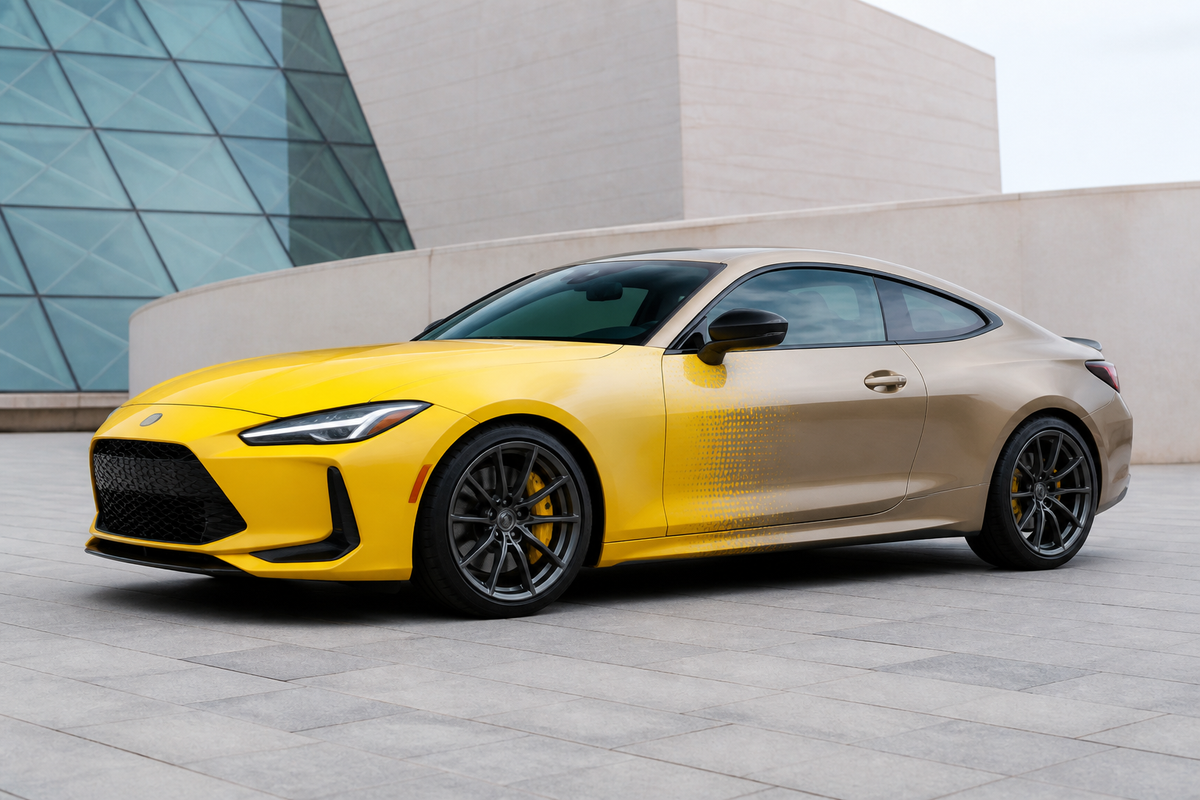
Quick answer: Maize yellow gloss and Champagne gold metallic solve different ownership problems. Use the comparison below, approve physical samples or a real tool path, measure the actual vehicle, and treat $154.99–$449.99 USD as dated material context—not a complete installed quote.
Verified facts that shape this decision
- The live U.S. yellow collection showed listed vinyl options from $154.99 to $449.99 USD on August 18, 2026; colored PPF entries were excluded from this vinyl range. Live storefront basis.
- Tesla's current Model 3 manual lists a 185.8-in overall length and 72.8-in body width excluding mirrors.
- Ford lists the 2026 Bronco Base four-door at 189.4 in long and 75.9 in wide with mirrors folded.
Match color energy to the ownership goal
| Option | Visual or work effect | Planning issue | Best fit |
|---|---|---|---|
| Maize yellow gloss | High chroma and strong contrast | Shows sharp reflections | Bold daytime statement |
| Champagne gold metallic | Warmer, quieter neutral | Metallic flake softens color shifts | Luxury-oriented restyle |
| Yellow accent | High contrast in a small area | Lower material exposure | Roof, mirrors or graphics |
Compare undertone before brightness
Maize yellow can lean warm or slightly green depending on adjacent black trim, glass and lighting. Champagne gold can move from beige to warm metallic. Put both samples beside the wheel finish and interior visible through the glass; a body color does not exist in isolation.
Use four lighting positions
Photograph each sample in open sun, full shade, indoor white light and warm parking-garage light. Keep camera exposure fixed if possible. The goal is not a perfect color photograph; it is a record of whether the preferred sample stays recognizable across ordinary conditions.
Plan repairs with direction and lot in mind
A highly noticeable yellow door replacement can expose even a small shade difference. A metallic gold repair can expose a direction change. Save a labeled offcut from the production lot and record vehicle-front direction on every cut piece.
Treat the published range as material context
The dated range compares listed vinyl products, not equivalent full-vehicle packages. Roll length, sale status, preparation, freight, taxes, labor and panel complexity all change the project. A measured cut map should choose the variant; the price should not choose the coverage.
Vehicle-size examples with a verified basis
Tesla Model 3 sedan
Tesla's current Model 3 owner's manual lists 185.8 in (4,720 mm) overall length and 72.8 in (1,850 mm) width excluding mirrors; values are approximate and configuration-dependent. Official dimension source. On the lower sedan, yellow concentrates attention on the hood and shoulder line; a gold roof can read as a separate design element. These published dimensions are a comparison basis; measure the actual panels, parts and edge returns before ordering.
2026 Ford Bronco Base four-door SUV
Ford lists the four-door Bronco Base at 189.4 in long, 75.9 in wide with mirrors folded, and 73.0 in high with the soft top. Official dimension source. The taller SUV creates more large vertical fields, so champagne gold may appear calmer while vivid yellow dominates the whole silhouette. These published dimensions are a comparison basis; measure the actual panels, parts and edge returns before ordering.
Price range in USD on August 18, 2026
The verified U.S. storefront context for this article is $154.99–$449.99 USD. The live U.S. yellow collection showed listed vinyl options from $154.99 to $449.99 USD on August 18, 2026; colored PPF entries were excluded from this vinyl range. This range does not combine taxes, local labor, freight exceptions, paint correction, disassembly, failed-piece allowance or future removal. Confirm the exact product, variant, availability and sale state when ordering.
- Measure every named panel at its widest usable points.
- Define jambs, roof, bumpers, trim, hardware and edge returns as included or excluded.
- Reserve direction and same-lot material where the exact finish requires it.
- Price preparation and installation separately from the roll or tool.
Installation guidance with an attributable basis
3M's color-change bulletin says metallic, pearl and color-flip materials can be directional and recommends consistent orientation and same-lot material. Use the exact film's arrows and technical sheet; the guidance is not proof that every listed WINWAYWRAP film behaves identically. Read the manufacturer bulletin.
- Inspect paint, repairs, textured plastics, sensors and moving parts.
- Photograph the approved sample, coverage boundary or cutting path.
- Build a panel-by-panel cut and direction map before opening the roll.
- Prepare the surface only with the exact film maker's permitted products.
- Use heat, solution, edge treatment and post-heating only as the selected system documents.
- Inspect after cooling or curing, record the product and lot, and deliver care instructions.
Commercial and editorial next steps
Compare the verified product and collection options below, then return to WINWAYWRAP vehicle-wrap materials for the current store view.
Related reading:
Questions to settle before approval
Can published vehicle dimensions replace measurements?
No. They make the sedan and SUV examples comparable, but they do not describe hood width, bumper depth, mirror geometry, aftermarket parts or the installer's handling margin.
Is the low price a full-vehicle price?
No. It is the low end of the specifically dated storefront context described above. Coverage, roll length, material family and service scope must match before prices are compared.
Can the installation setting in one bulletin be copied to another film?
No. The bulletin supports a practical workflow and shows what must be documented. The exact purchased film's current technical sheet controls temperatures, solutions, conformability, edge treatment and care.
What makes the final decision defensible?
Keep four records together: the approved physical sample or tool path, the measured cut map, the dated USD material source and the exact installation bulletin. If one is missing, keep the project in planning rather than forcing a purchase.
Final decision
Maize Yellow vs Champagne Gold Wrap: Brightness, Tone and Budget is not a choice that a color name, tool name or vehicle class can answer alone. Select the option whose appearance and workflow still make sense after the actual vehicle, repair plan, care routine and complete quote are considered.
Create a repair plan before installation
Identify which panel is most likely to be damaged and whether Maize yellow gloss or Champagne gold metallic can be replaced as one bounded piece. Save the exact product handle, lot, direction and a clean labeled offcut when practical. A first-day seamless look should not make a later repair unnecessarily broad.
Use a written acceptance checklist
Inspect the result in open light and side light. Check finish consistency, edges, seams, moving parts, sensors, trapped contamination and alignment with the approved plan. Photograph the accepted condition and keep the care sheet with the invoice.
Translate measurements into usable material
Draw each panel as a measured rectangle or pattern on the usable roll width, preserve direction, and add the handling margin chosen by the installer. Bumpers and compound parts deserve separate pieces because visible area alone understates their working-film demand.
Check the delivered material before cutting
Match the product title, handle, color, finish, width, length and lot to the order. Inspect packaging and a small unrolled section under neutral light. If multiple rolls are required, compare them before the first visible panel is installed.
Document the ownership plan
Record washing method, storage conditions, stain response, inspection timing and future removal guidance for the exact material. These variables can change which of the comparison options is genuinely easier to own.
Share:
Satin Pearl White Wrap vs Gloss and Matte White
Sky Blue vs Miami Blue Wrap: A Daylight and Vehicle-Shape Test